Calculate your income tax in 2 minutes. Compare both regimes side by side and pick the one that saves you more.
100% FreeNo Sign up required
Instant ResultsAccurate & Up-to-date
Private & SecureYour data is safe
Income Tax Slabs FY 2026-27 (AY 2027-28)
Old Regime (With Deductions)
Income Range (₹)
Tax Rate
Up to 2,50,000
Nil
2,50,001 – 5,00,000
5%
5,00,001 – 10,00,000
20%
Above 10,00,000
30%
Benefit of Section 87A
No tax up to ₹5 lakh (Old Regime) and up to ₹12 lakh (New Regime) under Section 87A rebate.
New Regime (Lower Tax Rates)
Income Range (₹)
Tax Rate
Up to 4,00,000
Nil
4,00,001 – 8,00,000
5%
8,00,001 – 12,00,000
10%
12,00,001 – 16,00,000
15%
16,00,001 – 20,00,000
20%
20,00,001 – 24,00,000
25%
Above 24,00,000
30%
These are the latest slab rates used in this calculator. New-regime tax up to ₹12 lakh is waived by Section 87A for residents, with marginal relief just above that. Salaried standard deduction of ₹75,000 makes the effective tax-free limit ₹12.75 lakh. Senior citizens get a ₹3 lakh old-regime exemption; super seniors get ₹5 lakh. 4% cess applies on tax due.
Know your calculator
What is an Income Tax Calculator and how does it work
An Income Tax Calculator is an online tool that tells you how much income tax you'll owe this financial year, based on your salary or total income, age and deductions. It applies the latest tax slabs set by the Income Tax Department — under both the old tax regime and the new tax regime — so you can see for yourself which one works out better.
Read moreRead less
The New Tax Regime has been the default regime since FY 2025-26 (following the 2025 Union Budget), with lower rates and a full rebate under Section 87A that makes tax zero up to Rs 12 lakh.
The Old Regime has higher rates, but if you have 80C investments, health insurance, home loan interest or HRA, the old regime can still work out cheaper.
This calculator models section-wise caps (80C, 80CCD(1B), 80D, 80TTA/TTB), the HRA exemption formula, and income/loss from house property, including the Rs 2 lakh cap on set-off of house-property loss. It doesn't model capital gains, other special-rate income, or the exact 80G fund-wise limits (50%/100%, with or without a qualifying cap) — those need a closer look. For an exact figure, especially if your income is above Rs 50 lakh or comes from multiple special-rate sources, please confirm with a Chartered Accountant or the official Income Tax e-filing portal.
Benefits of using this calculator
Avoids manual calculation errors
Gives a side-by-side comparison of Old vs New regime
Makes investment planning and tax saving decisions easier
Gives you an estimate before you file your ITR
How to use the calculator
01Fill in the Income section
Your gross salary, other income, interest, and any rental income or home loan interest, from your salary slip or Form-16.
02Choose your age category
Tax slabs and some deduction caps (80D, 80TTA/TTB) change by age, especially for senior citizens under the old regime.
03Fill in Deductions and HRA Exemption (if any)
Enter your 80C, 80CCD(1B), 80D, 80G, 80E and 80TTA amounts, plus your HRA details — these only apply to the old regime calculation.
04Check the result
The calculator instantly shows the tax under both regimes, with caps and the HRA formula already applied, and tells you which one is better for you.
Who this is useful for
Salaried employees and pensioners
Freelancers and business owners
Senior citizens, who get a different exemption limit
Anyone thinking about switching regimes
Which one fits you
Old Regime vs New Regime — Which Should You Pick
Choose the New Regime if
You don't have many investments or deductions
Your income is around Rs 12-13 lakh (tax could be zero)
You want simple, low-compliance filing
Choose the Old Regime if
You have a lot of deductions — HRA, home loan interest, 80C investments
Your total deductions add up to more than Rs 3.5-4 lakh
You've already invested in tax-saving instruments like LIC, PPF or ELSS
The right approach is to enter your actual deductions into the calculator above and compare the real numbers for both regimes — this decision depends entirely on your own income and deductions.
Common doubts
Frequently Asked Questions
How does the Income Tax Calculator work?
You enter your annual income, age and deductions, and the calculator instantly works out your tax under both the old and new regimes using the latest tax slabs, so you can pick the better regime.
What is the difference between Old regime and New regime?
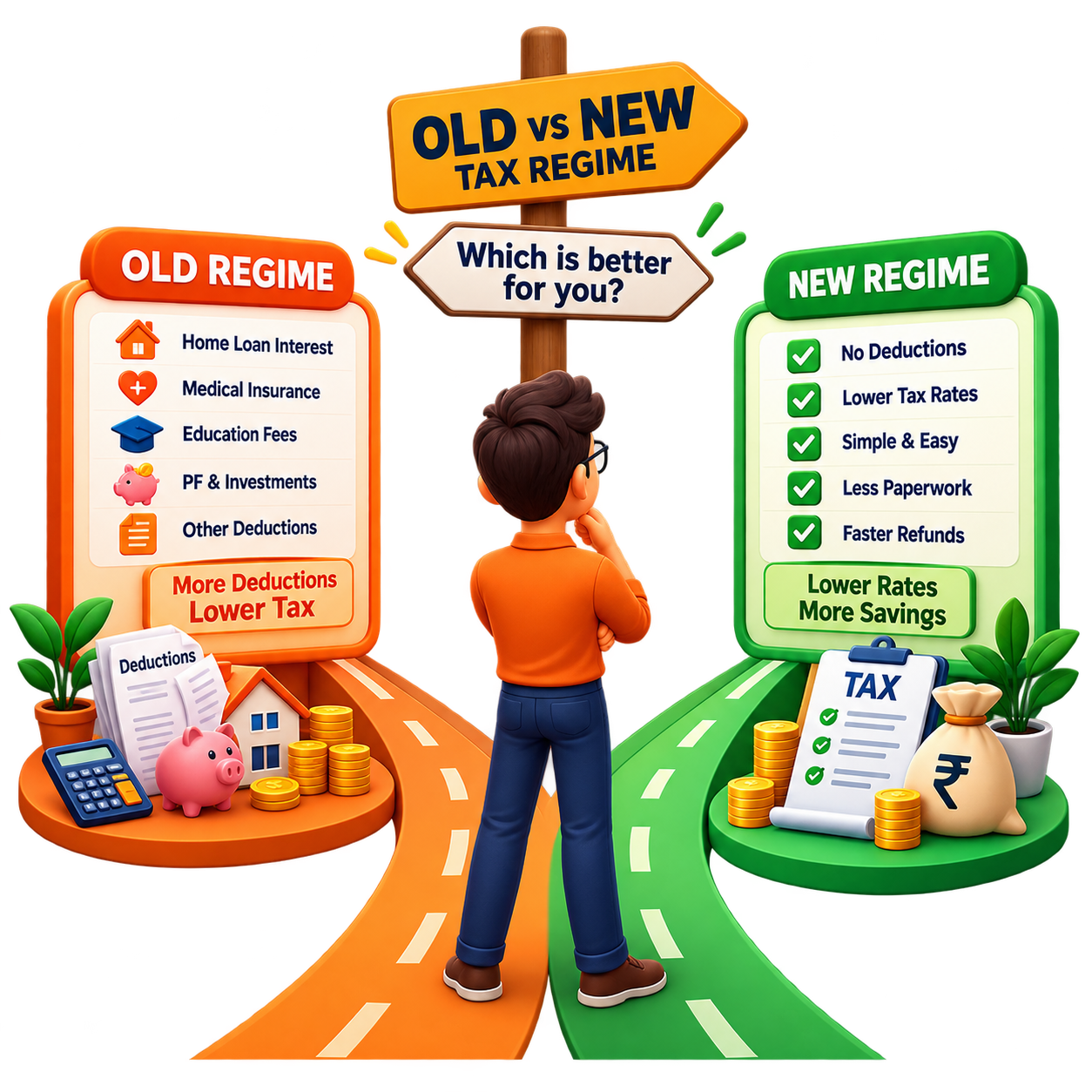
The New regime has lower tax rates but doesn't allow most deductions. The Old regime has higher rates but lets you claim deductions like 80C, 80D and HRA. Whichever gives you the lower final tax is the better regime for you.
Why is there no tax up to Rs 12 lakh?
Under the New tax regime, Section 87A gives a full rebate on taxable income up to Rs 12 lakh, making the effective tax zero. For salaried individuals, the standard deduction pushes this limit up to Rs 12.75 lakh.
What happens if my income is just above Rs 12 lakh — do I suddenly pay Rs 60,000 tax?
No. This is where "marginal relief" applies. If your New Regime taxable income is, say, Rs 12,00,001, you don't jump straight to the full slab tax of around Rs 60,000. Instead, marginal relief caps your tax so it can never be more than the amount by which your income exceeds Rs 12 lakh — so at Rs 12,00,001 you'd owe roughly Re 1 in tax, not Rs 60,000. This relief phases out gradually as your income moves further past Rs 12 lakh, and a similar rule applies just above the Rs 5 lakh threshold in the Old Regime.
Can I switch regimes every year?
Salaried individuals can switch regimes every financial year while filing their ITR. Those with business income can only switch back once, so they need to think it through more carefully.
What is the standard deduction?
The standard deduction is a flat amount automatically subtracted from the gross income of salaried employees and pensioners, without needing any proof. It's Rs 75,000 under the new regime and Rs 50,000 under the old regime.
This calculator is meant for estimation and general awareness only. For your exact tax liability and filing, please confirm with a Chartered Accountant or the official Income Tax portal (incometax.gov.in).